MVP web application development: scope a first release customers can use
An MVP should let a real user complete a valuable task and let the business learn from that use. It should not be a collection of unfinished screens. Start with one end-to-end workflow, decide what can remain manual and define evidence that would justify the next release.
Key takeaways
- A complete narrow workflow beats many disconnected features.
- Manual operations can be deliberate, but ownership must be defined.
- Measure completion and failure, then use the evidence to set the next scope.
Define the first user, task and evidence
Describe the intended first user in operational terms: a freelancer submitting a request, a supplier receiving an order or a customer booking an appointment. Name the task they want to complete and the result they expect. “A platform for everyone” is too vague to guide a first release; a single reliable workflow provides a clearer target.
Next, state what you need to learn. Will users finish the process without help? Will operators be able to handle the requests? Will someone return to perform the task again? Treat these as questions to observe, not guaranteed growth outcomes. Choose a small set of completion and failure events, plus a way to collect feedback. Avoid measuring only registrations when the valuable action happens later.
- Name one first user group
- Choose a completed task
- Define learning questions
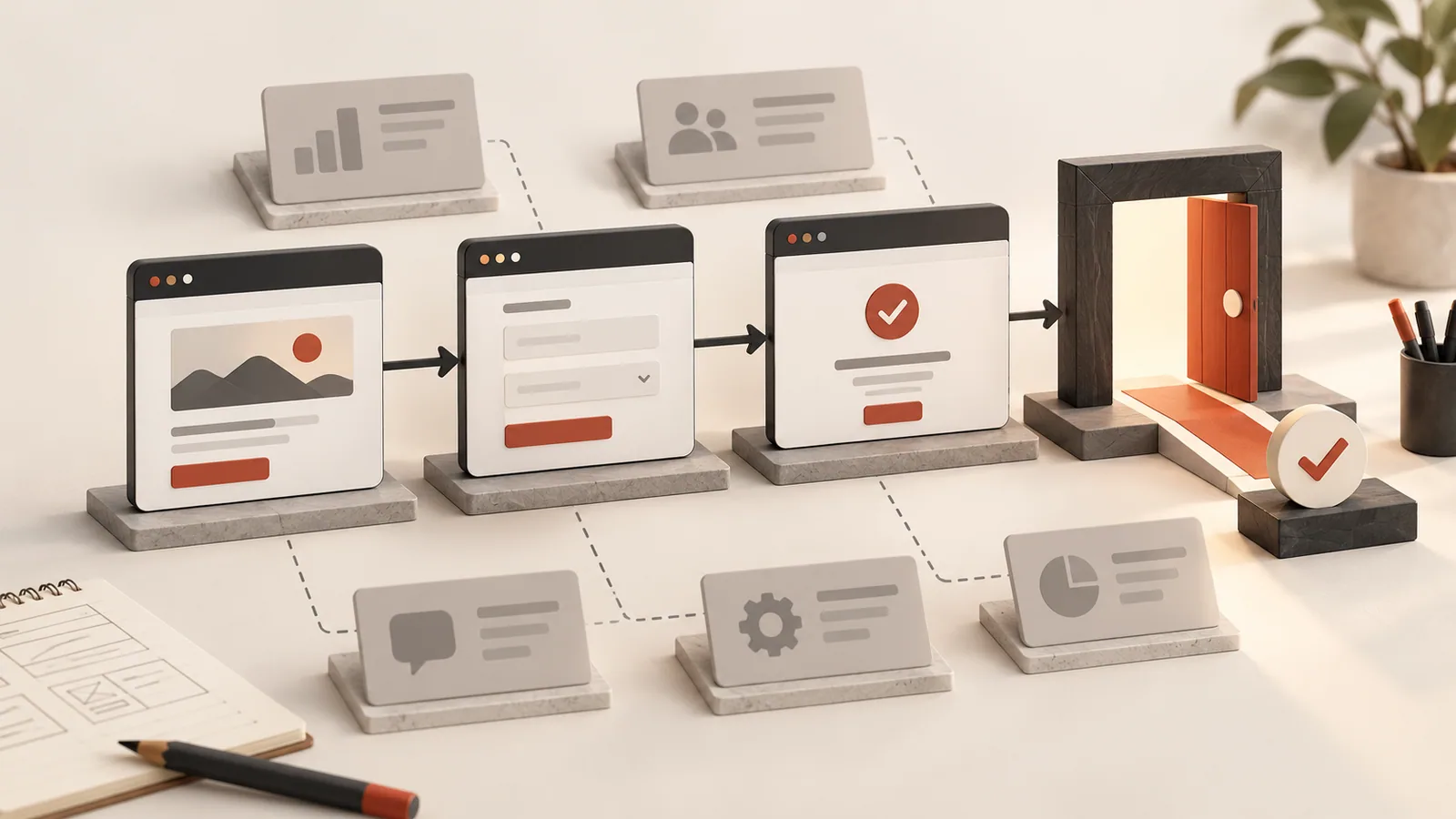
Draw the entire workflow, including the operator’s side
Follow a record from creation to completion. A request form is incomplete if nobody can find the submission; a booking tool is incomplete if staff cannot correct a mistake. Include notifications, admin review, status changes and the user’s ability to understand what happened. These operational steps often matter more than an additional polished dashboard.
Separate the happy path from failures. What if payment is declined, a file upload is interrupted or a confirmation email does not arrive? An MVP can use a modest interface and manual support, but it still needs clear states and recoverable errors. Write acceptance scenarios for the whole flow so a demonstration cannot substitute for a working first product.
- Include admin and support actions
- Name failure states
- Write end-to-end acceptance scenarios
Decide what to build, do manually and defer
Classify each proposed feature by the risk it resolves in the first release. Essential work completes the user task or protects important data. Manual work is a deliberate operational step with a named owner. Deferred work should wait because its value is uncertain or because simpler behavior is sufficient for the pilot.
This is different from cutting quality indiscriminately. Access control, backups and a dependable form are not equivalent to animation options or advanced reporting. Document any manual workaround and its capacity: who performs it, how often and what would signal that automation is necessary. A manual process becomes a trap when nobody owns it or when it cannot cope with the intended pilot.
| Area | First release | Later if evidence supports it |
|---|---|---|
| Requests | Submission, review and status | Automated assignment and routing |
| Accounts | Necessary roles and access | Additional role hierarchies |
| Reporting | Basic operational visibility | Custom dashboards and forecasts |
| Messaging | Essential confirmations | Complex campaign automation |
- Separate essential behavior from polish
- Name each manual operation owner
- Set a trigger for later automation
Choose an architecture that can be extended without overbuilding
Define a clear data model, a small set of permissions and a deployment process the team can operate. Keep modules understandable and avoid coupling every feature to a single giant screen. These choices make change easier without requiring a speculative enterprise architecture before you have real users.
Use established services where they fit the requirements, but record what they handle and what remains your responsibility. Authentication does not automatically supply record-level permissions. A payment provider does not decide how an order should recover after an interrupted webhook. A sensible MVP uses a focused stack and explicit boundaries; it does not make “quick launch” an excuse to leave important behavior undefined.
- Keep data and permissions explicit
- Document service boundaries
- Avoid unnecessary deployment complexity
Budget around uncertainty, not a list of page names
Ask for a proposal that separates known work from assumptions. A payment integration, data import or multi-role workflow can change the estimate more than another static page. Resolve the highest-risk dependency early with a small technical check, then refine the scope. A fixed date without a plan for these uncertainties is not a reliable launch plan.
Use milestones with observable outputs: an agreed workflow, an integrated end-to-end slice, a tested pilot and a production handover. State which content and decisions the owner must provide. Leave time for realistic test data and corrections after the first use. The first release should have an explicit support window rather than ending when files are uploaded to hosting.
- Identify the uncertain integration
- Tie milestones to behavior
- Plan pilot feedback and support
Launch with a small group and a repeatable review process
Invite a manageable pilot group and observe where they hesitate, abandon the task or need assistance. Record support issues alongside analytics so you can tell the difference between a user-interface problem and missing product value. Check completed tasks, repeat use and operational burden rather than celebrating a large number of incomplete signups.
Before expanding the scope, decide which problems deserve attention now. Fix reliability and confusing steps in the core workflow before adding more optional features. Keep a short change log, a prioritized backlog and ownership for monitoring and backups. An MVP succeeds as a learning tool when the next decision follows evidence rather than whichever feature idea was mentioned most recently.
- Observe real task completion
- Review support and operational effort
- Prioritize the next release from evidence
Sources and further reading
Primary documentation for the platform-specific details discussed in this article. The planning examples above are illustrative requirements, rather than client case studies.
Turn the idea into a buildable first release
Send the first user task, must-have integrations and your constraints. I can help define an MVP scope with clear delivery and launch criteria.
Discuss a projectFrequently asked questions
Practical answers to help you plan the next step.
The timeline depends on the workflow, integrations, content and testing. A scoped end-to-end release gives a more reliable estimate than an unspecified list of pages or a promised universal schedule.
Yes, when a named person can operate them reliably during the pilot. Keep important user-facing states, permissions and recovery behavior explicit, and set a trigger for automation.
No. Launch when the core task works, operational ownership is clear and the first users can give useful feedback. Defer uncertain features without deferring essential reliability.