Web development discovery checklist before scope and quote
Web development discovery should turn an unclear request into decisions that make the project possible to scope and build. The output is not a longer list of features. It is a shared understanding of users, workflows, content, integrations, constraints and the first release. Use this checklist before requesting a detailed quote, especially when the website must replace an existing process or connect several business systems.
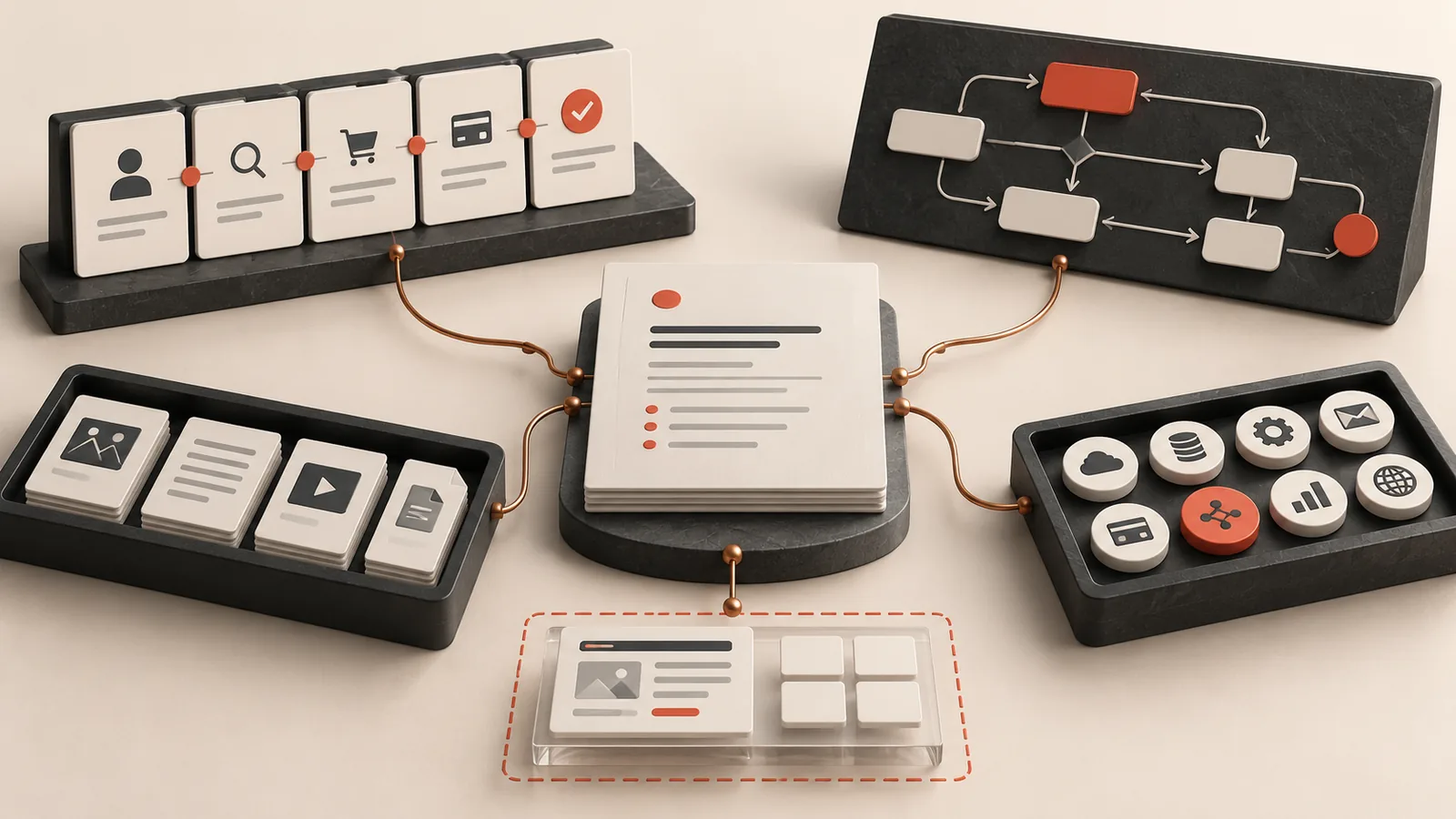
Key takeaways
- Discovery should produce decisions, assumptions and testable requirements.
- Include the people who operate the business workflow, not only the project approver.
- Resolve the most consequential uncertainty before committing to the full build.
Start with the current process and its actual friction
Ask the people doing the work to demonstrate a recent, representative journey. Follow the enquiry, order or client request through each handoff. Record the information they need, where it lives and what they do when something is missing. The most useful detail often appears in the spreadsheet or email step that was not mentioned in the original feature list.
Separate observations from explanations. 'Staff enter the same order in two systems' is an observable problem; 'we need a new CRM' is a proposed solution that still needs evaluation. Identify the cost or consequence of the current friction without inventing a precise saving. This gives the project a clear reason to exist and helps avoid automating a process that first needs a simpler agreement between the people involved.
- Walk through a real type of task with representative sample information.
- Record the problem separately from the first suggested solution.
Map users, decisions and exceptions
Describe the different users and what each needs to complete. A customer, an approver, an editor and a support person may interact with the same record for different reasons. Write the normal sequence, then add the exceptions that change its meaning: cancellation, missing information, a failed payment or a request to revise an approved item.
Identify who can make each decision. If one team believes an order is final after payment and another changes it during fulfilment, the application needs an agreed rule. Discovery is the right place to surface that disagreement. Keep the map understandable enough that the business can review it without interpreting a technical diagram. A short workflow with clear ownership is more valuable than a large drawing nobody uses to make decisions.
| Discovery area | Question | Reviewable output |
|---|---|---|
| Users | Who does what, and with which access? | Roles and main journeys |
| Workflow | What starts and completes the work? | States, decisions and exceptions |
| Content | What must be written, edited or migrated? | Inventory with owners and gaps |
| Integrations | Which system owns the data? | Data movement and unresolved constraints |
| Release | What must be complete before launch? | First-release scope and acceptance checks |
- Give each important state and decision an owner.
- Include the exceptions that affect customers or operational accuracy.
Inventory content, data and integrations early
List the material the build depends on: service copy, product records, images, account information, documents and existing URLs. Check whether it is usable, accurate and available to the project. Assign an owner to missing items. A schedule that assumes content will appear later without a responsible person is carrying a dependency that deserves to be visible.
For integrations, confirm access to current documentation and a suitable test setup. Identify the required operations and who controls the external account. Mark unknowns explicitly instead of silently turning them into included scope. If an existing dataset needs cleaning or mapping, treat that as work with an acceptance method. Moving a file is not the same as making its records correct and usable in a new application.
- Record content readiness and the person responsible for each gap.
- Verify important integration and migration assumptions before estimating them.
Define the first release and its acceptance scenarios
Describe the smallest complete service you can put in front of a user. Include the staff actions needed to support it, not only the public screens. Decide which tasks can remain manual temporarily and which must be automated because mistakes would be costly or confusing. Keep later ideas in a separate backlog with a reason for revisiting them.
Turn key requirements into plain acceptance scenarios. Explain the starting state, the action and the expected result. Include at least one meaningful failure or exception for the most important workflow. These scenarios help design, development and review stay aligned. They also make a proposed scope easier to price because the developer can see what the business expects to inspect rather than guess what a feature label implies.
- Keep one complete primary journey inside the first-release boundary.
- Write normal and failure scenarios for the business-critical actions.
Close discovery with decisions and a next step
Create a concise record of agreed requirements, important assumptions, unresolved questions and exclusions. Give each unresolved item an owner and explain whether it prevents estimation or can be handled within a limited allowance. If a technical proof is needed, specify what it will establish and when the result will be reviewed. Discovery should reduce uncertainty rather than become an indefinite project stage.
Use the output to shape a proposal, prototype or focused investigation. Agree how later changes will be evaluated and who consolidates feedback. The depth of discovery should suit the project: a small website may need a short structured conversation, while a connected business application needs more operational detail. Both deserve clarity about what is being built, why it matters and how completion will be recognised.
- Publish a short decision and assumption record for the project team.
- Connect every remaining uncertainty to an owner and a practical action.
Sources and further reading
Primary documentation for the platform-specific details discussed in this article. The planning examples above are illustrative requirements, rather than client case studies.
Have an idea that is not ready for a detailed quote?
Share the goal, the current process and the decisions you are unsure about. I can help turn that into a focused scope, identify the open questions and define a useful next step.
Discuss a projectFrequently asked questions
Practical answers to help you plan the next step.
Yes, but it can be lightweight. Even small projects need clarity around goals, pages, content, launch access and success metrics.
For serious custom work, yes. A developer can give a rough range early, but accurate scope and pricing need discovery.
Only talking about design while ignoring content, integrations, SEO, analytics, admin workflows and post-launch ownership.